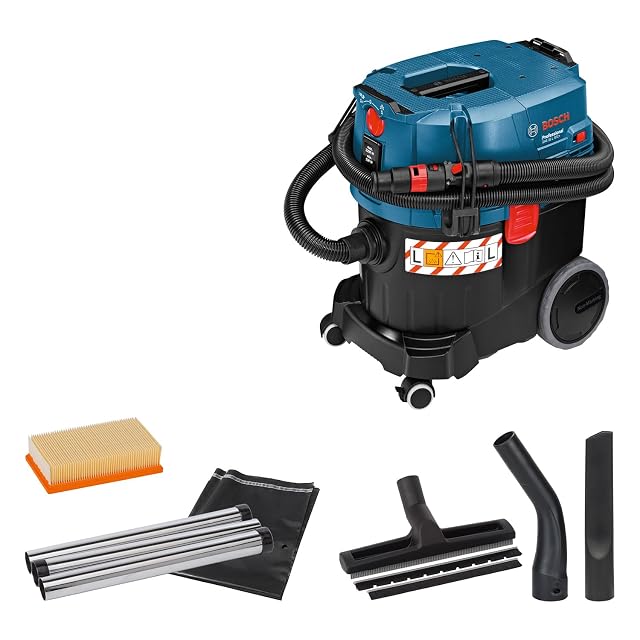
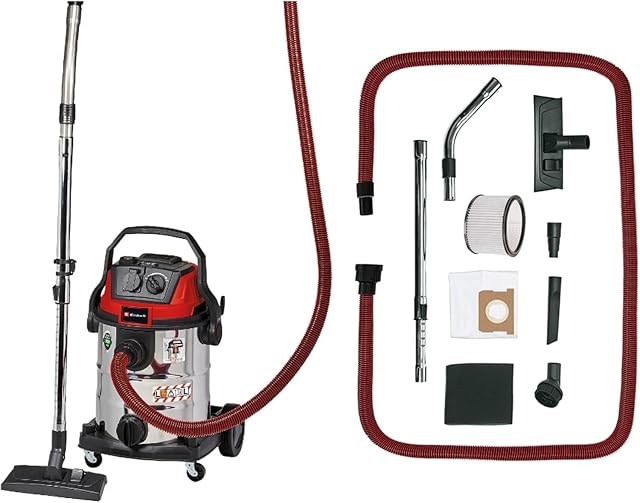
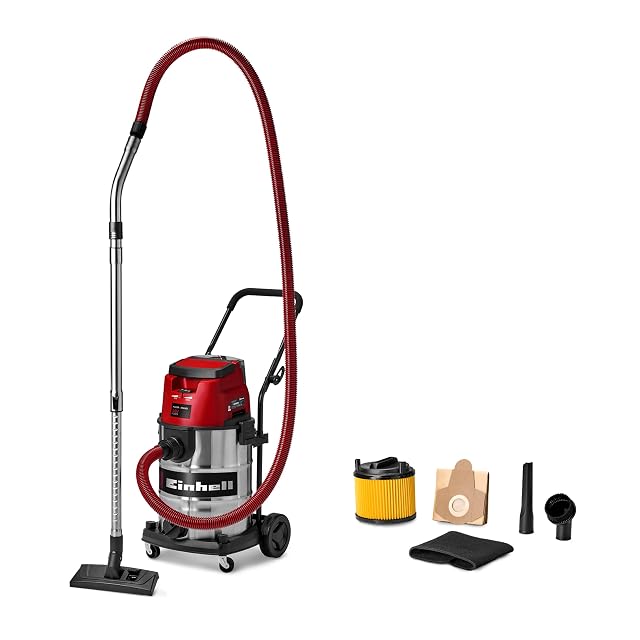
The bottom line The right shape of machine for the big ports, at a price that makes the argument easy.
Hands-on testing pending. Nothing below is presented as our own
measurement. Every figure is a manufacturer specification, read off the
listing itself, and the judgements are ours — drawn from how the
specification behaves in this class of machine and from what long-term
owners consistently report. Where a figure is missing, we say so rather
than fill it in.
What the specification says
A wheeled chip collector supplied with four machine adaptors, part number
5906307901-500. Scheppach publishes neither an airflow figure nor a filter grade
on this listing.
Two machines, not one
A chip collector moves a large volume of air at low pressure. It
suits a 100 mm port on a planer, a table saw or a band saw, where the
waste is bulky and the duct is wide.
A workshop vacuum moves a small volume at high pressure. It suits a
32 or 35 mm hose on a sander, a router or a track saw, where the waste
is fine and the port is narrow.
Swap them and each collects almost nothing, while sounding exactly as
though it is working. It is the most expensive misunderstanding in the
category, and no listing explains it.
This is the other half of that pairing: the machine for the 100 mm ports. It is
also the reason a workshop ends up owning two extractors rather than one.
Dust class L or M — the letter that matters
European workshop vacuums carry a dust class. L lets through up to
1 % of the dust it collects; M lets through up to 0.1 %, ten times
less. Both look identical and both say “dust extraction” on the box.
Wood dust is classified as a Group 1 carcinogen by the IARC, and the
harmful fraction is the fine one that a filter either holds or does not.
For hardwood in an enclosed workshop, M is the class to look for. An
L-class machine is not useless — it collects chips perfectly well — but
it returns ten times more of the fraction you cannot see to the room you
are standing in.
Chip collectors are not classed the way workshop vacuums are, which is precisely
why the filter grade is worth asking about before ordering.
Availability
One reference and one EAN across all six markets: €139 in Germany, €150 in
France, €154 in Spain, €185 in Britain, €188 in Italy, €379 on amazon.com.
Prices quoted in this text were read on 2026-08-12. The live price is at the top of the page.
What we like, and what we don't
Strengths
A genuine chip collector rather than a vacuum sold as one
Four adaptors included — the parts that never quite fit otherwise
Wheels, which matter because one collector serves several machines
Compromises
The listing publishes no airflow figure and no filter class
Chip collectors with bag filters return fine dust to the room
The American price, at €379, is an importer's
Specifications
Type
Chip collector (Späneabsaugung)
Mobility
Wheeled base
Supplied with
4 machine adaptors
Part number
5906307901-500
Amazon reference
B09JGRN71Y (identical on 6 markets)
EAN
4046664127413
Questions people actually ask
Do the four adaptors really matter?
More than you would think. Machine ports are not standardised — 100 mm, 63 mm, 35 mm, and several proprietary ovals — and the adaptor you need is always the one not in the box. Four included is four purchases you do not make and four hose connections that actually seal.
Is the bag filter enough?
For chips, yes. For the fine fraction, a standard bag filter is porous enough that a good deal passes back into the room — which is why serious workshops add a cyclone separator ahead of the collector and an ambient air filter above the bench. The listing does not state a filter grade here, which is worth asking about.